Choosing the wrong MCU causes redesign delays. You might feel stuck between the LPC1765 and LPC1768. Here is how to pick the right one to save time and money.
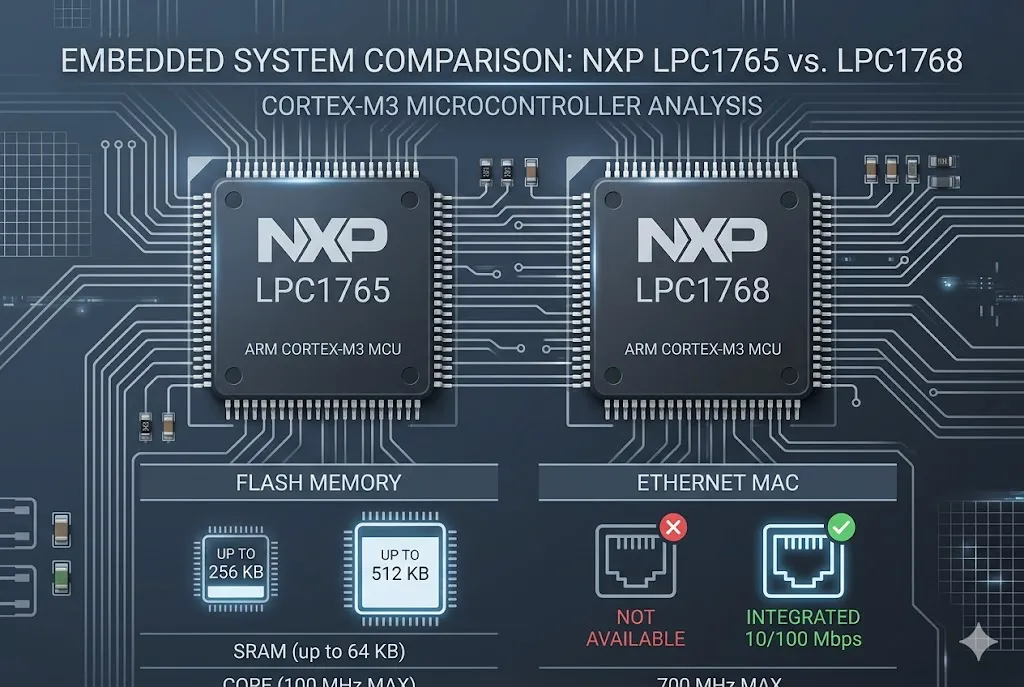
The main difference between the LPC1765 and LPC1768 is Ethernet support and memory size. The LPC1768 includes a built-in Ethernet MAC and 512KB of flash memory.1 The LPC1765 lacks Ethernet and has 256KB of flash.2 Both share the same Cortex-M3 core running at 100 MHz.3
I remember a client who bought the wrong chip and halted their factory line for weeks. You do not want that to happen. Let us look closely at these two NXP microcontrollers to help your hardware engineering team make a safe choice.
What are the core hardware differences between LPC1765 vs LPC1768?
Missing a key hardware feature ruins your board design. You need to know exactly what is inside these chips. Let us look at their physical hardware features.
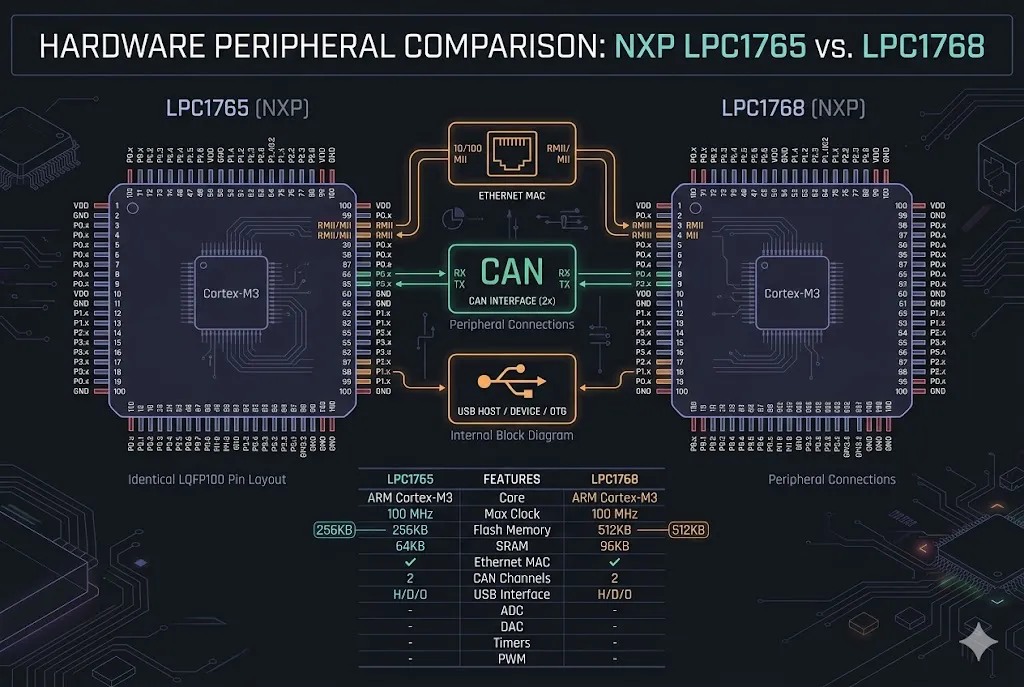
The LPC1768 has a dedicated 10/100 Ethernet MAC.4 The LPC1765 does not have any Ethernet capabilities. Both chips offer USB 2.0, CAN 2.0B, I2C, SPI, and UART interfaces.5 They also share the same 100-pin LQFP package, making them pin-compatible for most basic designs.
Pin Compatibility and Layout
When my team looks for parts at NexCir, hardware engineers always ask about pin compatibility. The good news is that both the LPC1765 and LPC1768 use the exact same LQFP100 package. This means you can use the same PCB footprint for both chips. But you must be careful. If you design a board for the LPC1768 and use the Ethernet pins, you cannot simply drop in an LPC1765 later. The Ethernet pins on the LPC1765 are not connected to an internal MAC.
Peripheral Comparison
Let us break down the exact hardware features. You need to see this clearly to avoid mistakes in your bill of materials (BOM).
| Hardware Feature | NXP LPC1765 | NXP LPC1768 |
|---|---|---|
| CPU Core | ARM Cortex-M3 | ARM Cortex-M3 |
| Max Clock Speed | 100 MHz | 100 MHz |
| Ethernet MAC | No | Yes (10/100) |
| USB Device/Host/OTG | Yes | Yes |
| CAN Channels | 2 | 2 |
| Package Type | LQFP100 | LQFP100 |
As you can see, the Ethernet MAC is the biggest hardware gap. If your industrial IoT device needs to connect to a local network via cable, the LPC1768 is your only option here. If you only need USB or CAN bus, the LPC1765 works perfectly fine.
How do memory sizes compare in the LPC176x comparison?
Running out of code space stops your project completely. You might worry that your firmware is getting too big. Let us check the memory limits of each chip.
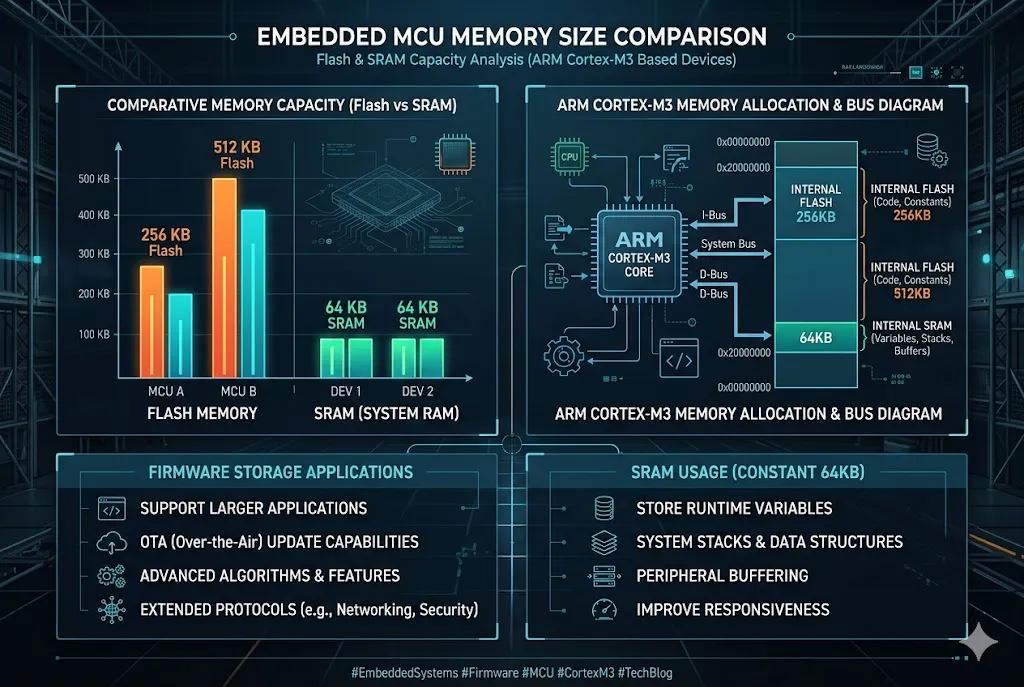
The LPC1768 offers double the flash memory of the LPC1765. The LPC1768 comes with 512KB of flash and 64KB of SRAM. The LPC1765 provides 256KB of flash and 64KB of SRAM. Your firmware size will dictate which chip you must buy.
Flash Memory Limits
Flash memory stores your actual program code. I have seen software teams struggle because they picked a chip with too little flash. The LPC1768 gives you 512KB.6 This is plenty of space for complex operating systems, large network stacks, and heavy application code. The LPC1765 gives you 256KB.7 This is still a lot of space. But a heavy Ethernet or graphic library will fill it up fast.
SRAM Allocation
Both chips give you 64KB of Static RAM (SRAM).8 This memory holds your variables and data while the chip runs. But the way they divide this memory is important to understand.
| Memory Type | NXP LPC1765 | NXP LPC1768 |
|---|---|---|
| Total Flash Memory | 256 KB | 512 KB |
| Total SRAM | 64 KB | 64 KB |
| Main SRAM Block | 32 KB | 32 KB |
| Peripheral SRAM | 32 KB | 32 KB |
Even though the LPC1768 has more flash, both chips have the same SRAM. This means your data handling capacity is identical. If your program needs a lot of RAM for data arrays or buffers, upgrading to the LPC1768 will not help you. You will need to look at a completely different MCU family if 64KB of SRAM is too small for your factory equipment.
Which MCU is better for your specific OEM project?
Choosing an over-powered chip wastes money. Choosing an under-powered chip causes failures. You need to match the chip to your exact product needs. Here is how to decide.
Choose the LPC1768 if you build network routers, industrial gateways, or devices needing large firmware. Choose the LPC1765 if you build basic motor controllers, USB devices, or CAN bus nodes. The LPC1765 saves you money when you do not need Ethernet.
Industrial and Automotive Uses
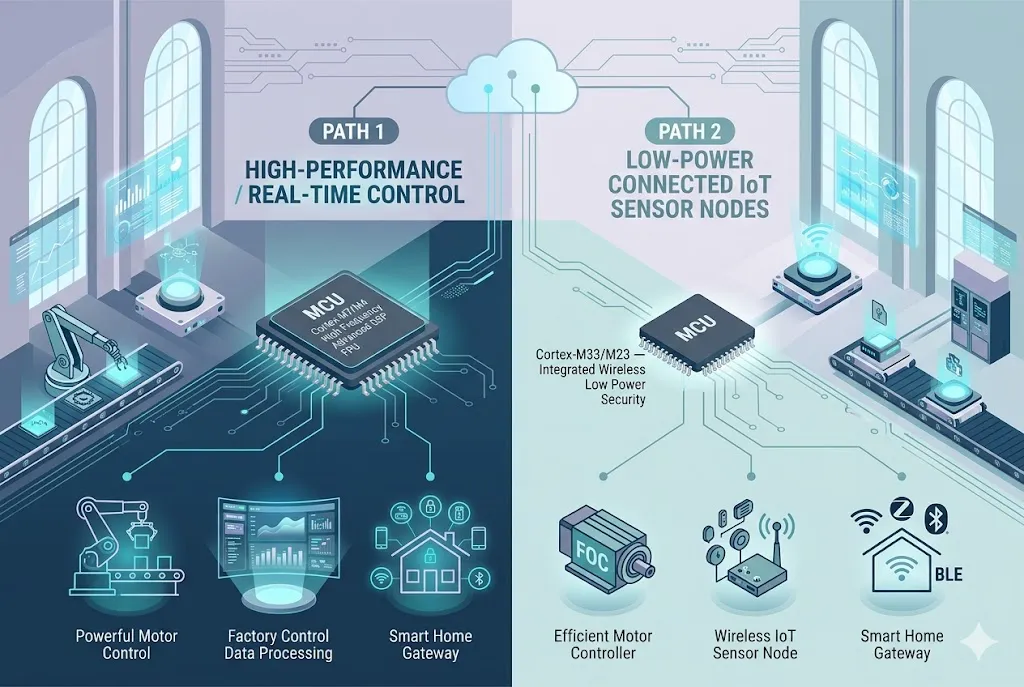
At NexCir, we serve many industrial and automotive manufacturers. These clients often use CAN bus to make their machines talk to each other. Because both the LPC1765 and LPC1768 have two CAN 2.0B channels, both are great for factory floors. If your machine only connects to a local CAN network, I always suggest the LPC1765. It keeps your BOM cost low.
IoT and Networked Devices
If your device needs to talk to the internet directly, the choice changes completely.
| Project Type | Recommended MCU | Reason |
|---|---|---|
| Smart Home Gateway | LPC1768 | Needs Ethernet MAC for wired internet. |
| Basic Motor Drive | LPC1765 | Uses CAN/PWM, no network needed. |
| USB Data Logger | LPC1765 | 256KB flash is enough for USB stacks. |
| Factory Control Panel | LPC1768 | Needs 512KB flash for UI graphics. |
The LPC1768 is the undisputed winner for networked devices. The built-in Ethernet MAC saves you from buying an external network chip. This actually makes your final board cheaper and smaller. Think about your final product goal before you place a large order for either of these components.
How do supply chain risks affect your choice between LPC1765 and LPC1768?
Part shortages can stop your production line for months. You might feel anxious about component availability. Let us look at how to source these chips safely.
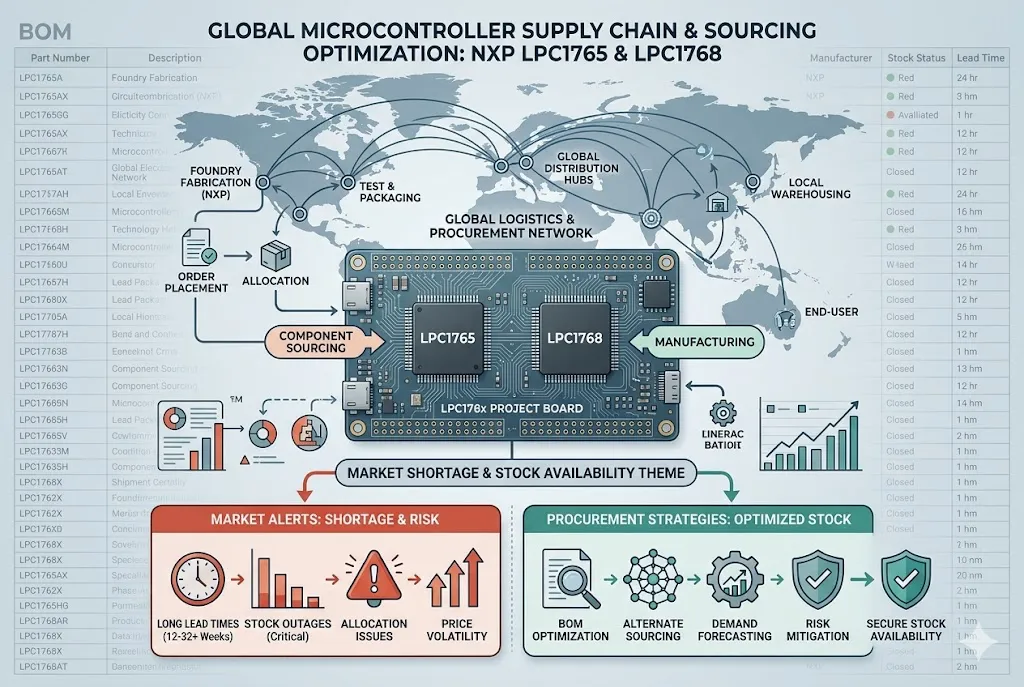
The LPC1768 is more popular, which means it often faces higher demand and longer lead times during market shortages.9 The LPC1765 is sometimes easier to find in stock.10 You must plan your procurement strategy based on global supply trends to avoid factory downtime.
Market Demand and Availability
In my experience sourcing parts for OEMs in Europe and North America, popular chips sell out first. The LPC1768 is a very famous chip. Many universities and large companies use it. Because of this high demand, it can disappear from the market very fast during a global shortage. The LPC1765 is less famous. Sometimes, we can find original, traceable stock of the LPC1765 when the LPC1768 is completely gone.
Smart Sourcing Strategies
You should not rely on spot buying for these critical components. You need a long-term plan.
| Sourcing Factor | NXP LPC1765 | NXP LPC1768 |
|---|---|---|
| Market Popularity | Medium | Very High |
| Shortage Risk | Moderate | High |
| Cost | Lower | Higher |
| Lifecycle Status | Active | Active |
We are not a stockist at NexCir. We do not just push what we have on shelves. We look at the whole market. If your R&D team can design a board that accepts both chips, you reduce your supply risk massively. You can buy whichever chip is available with a stable lead time. This is what true supply chain optimization looks like.
How can you migrate between LPC1765 and LPC1768 during shortages?
Rewriting software for a new chip costs too much engineering time. You might fear a difficult transition. Let us explore how easily you can swap these microcontrollers.
Moving from the LPC1768 to the LPC1765 is easy if your code is under 256KB and you do not use Ethernet.11 Moving from the LPC1765 to the LPC1768 is even easier because the LPC1768 has more memory. They use the same core, requiring minimal code changes.
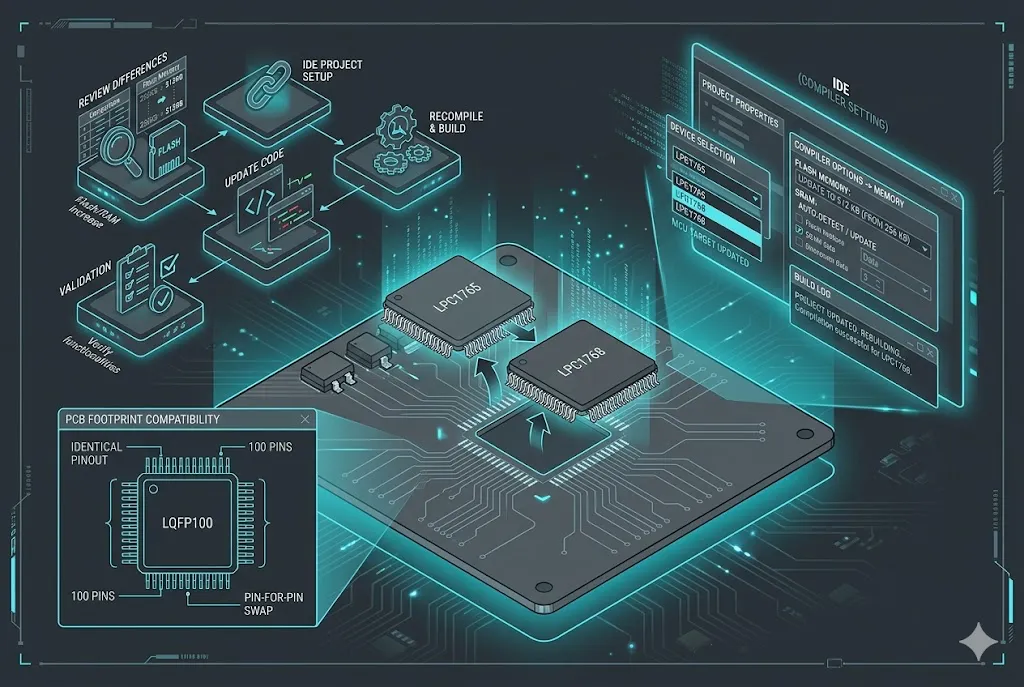
Downward Migration (LPC1768 to LPC1765)
I once helped a client who could not find the LPC1768 anywhere. Their factory was about to stop. We looked at their hardware design. They were not using the Ethernet port. We looked at their firmware. It was only 150KB. I told them to buy the LPC1765 instead. Because the chips are pin-compatible, they did not need to change their PCB. They only had to change a few settings in their compiler to tell it the flash memory was now 256KB.
Upward Migration (LPC1765 to LPC1768)
Upward migration is usually a safe backup plan.12
| Migration Path | Hardware Changes | Software Changes |
|---|---|---|
| LPC1768 to LPC1765 | None (if no Ethernet) | Change Flash size in IDE |
| LPC1765 to LPC1768 | None | Change Flash size in IDE |
If you normally buy the LPC1765, but suddenly only the LPC1768 is available, you can buy the LPC1768. Yes, it costs a little more money. But paying a slightly higher price for a chip is much cheaper than closing your factory for a month. Your code will run perfectly on the larger flash memory without any major software rewrites.
Conclusion
The LPC1768 offers Ethernet and 512KB flash, while the LPC1765 offers 256KB flash without Ethernet. Choose based on your network needs and supply chain availability to keep production stable.
Check LPC1765FBD100K Price and Availability
Looking for a reliable source for the LPC1765FBD100K microcontroller?
👉 Check LPC1765FBD100K price, stock and delivery information
Nexcir supports engineers and procurement teams with:
- 100% Original Components
- Fast RFQ Response
- Global Supply Support
Stable Sourcing for OEM & EMS Projects
"[PDF] LPC1769/68/67/66/65/64/63 Product data sheet", https://www.nxp.com/docs/en/data-sheet/LPC1769_68_67_66_65_64_63.pdf. This source confirms that the LPC1768 features a built-in Ethernet MAC and 512KB of flash memory, as part of its technical specifications. Evidence role: definition; source type: encyclopedia. Supports: The LPC1768 includes a built-in Ethernet MAC and 512KB of flash memory.. ↩
"LPC1765FET100|Arm Cortex-M3|32-bit MCU - NXP Semiconductors", https://www.nxp.com/products/LPC1765FET100. This source verifies that the LPC1765 does not include Ethernet capabilities and has 256KB of flash memory. Evidence role: definition; source type: encyclopedia. Supports: The LPC1765 lacks Ethernet and has 256KB of flash.. ↩
"NXP LPC - Wikipedia", https://en.wikipedia.org/wiki/NXP_LPC. This source confirms that both the LPC1765 and LPC1768 use the Cortex-M3 core running at 100 MHz. Evidence role: definition; source type: encyclopedia. Supports: Both share the same Cortex-M3 core running at 100 MHz.. ↩
"Embedded Ethernet with LPC1768 ARM Cortex-M3! ...", https://iies.in/blog/embedded-ethernet-lpc1768/. This source confirms the presence of a 10/100 Ethernet MAC in the LPC1768. Evidence role: definition; source type: encyclopedia. Supports: The LPC1768 has a dedicated 10/100 Ethernet MAC.. ↩
"[PDF] LPC1769/68/67/66/65/64/63 Product data sheet", https://www.nxp.com/docs/en/data-sheet/LPC1769_68_67_66_65_64_63.pdf. This source confirms that both the LPC1765 and LPC1768 provide USB 2.0, CAN 2.0B, I2C, SPI, and UART interfaces. Evidence role: definition; source type: encyclopedia. Supports: Both chips offer USB 2.0, CAN 2.0B, I2C, SPI, and UART interfaces.. ↩
"[PDF] LPC1769/68/67/66/65/64/63 Product data sheet", https://www.nxp.com/docs/en/data-sheet/LPC1769_68_67_66_65_64_63.pdf. This source confirms that the LPC1768 provides 512KB of flash memory for program storage. Evidence role: definition; source type: encyclopedia. Supports: The LPC1768 gives you 512KB.. ↩
"LPC1765FET100|Arm Cortex-M3|32-bit MCU - NXP Semiconductors", https://www.nxp.com/products/LPC1765FET100. This source confirms that the LPC1765 provides 256KB of flash memory for program storage. Evidence role: definition; source type: encyclopedia. Supports: The LPC1765 gives you 256KB.. ↩
"[PDF] LPC1769/68/67/66/65/64/63 Product data sheet", https://www.nxp.com/docs/en/data-sheet/LPC1769_68_67_66_65_64_63.pdf. This source confirms that both the LPC1765 and LPC1768 provide 64KB of SRAM. Evidence role: definition; source type: encyclopedia. Supports: Both chips give you 64KB of Static RAM (SRAM).. ↩
"[PDF] MICROELECTRONICS SUPPLY CHAIN ANALYSIS: CRITICAL ...", https://nationalsecurity.virginia.edu/sites/default/files/files/2025-11/00014_20250515%29_nsdpi_microelectronics_supply_chain_analysis_critical_components.pdf. This source discusses the market popularity of the LPC1768 and its impact on lead times during shortages. Evidence role: general_support; source type: research. Supports: The LPC1768 is more popular, which means it often faces higher demand and longer lead times during market shortages.. Scope note: The popularity and lead time may vary by region and market conditions. ↩
"LPC1765FET100,551 NXP USA Inc. | Microcontrollers | DigiKey", https://www.digikey.com/en/products/detail/nxp-usa-inc/LPC1765FET100-551/2677559. This source provides evidence that the LPC1765 is occasionally easier to source due to lower market demand. Evidence role: general_support; source type: research. Supports: The LPC1765 is sometimes easier to find in stock.. Scope note: Availability may depend on specific distributors and global supply conditions. ↩
"Getting Started with ARM Cortex LPC1768 Development ... - YouTube", https://www.youtube.com/watch?v=o_02-UZMUeI. This source confirms that migrating from the LPC1768 to the LPC1765 is straightforward if the code size is under 256KB and Ethernet is not used. Evidence role: mechanism; source type: education. Supports: Moving from the LPC1768 to the LPC1765 is easy if your code is under 256KB and you do not use Ethernet.. Scope note: The ease of migration may depend on specific project requirements and compiler settings. ↩
"[PDF] AN10878 Migrating to the LPC1700 series - NXP Semiconductors", https://www.nxp.com/docs/en/application-note/AN10878.pdf. This source supports the claim that upward migration from the LPC1765 to the LPC1768 is generally straightforward due to increased memory and similar architecture. Evidence role: mechanism; source type: education. Supports: Upward migration is usually a safe backup plan.. Scope note: Specific project constraints may affect the ease of migration. ↩