Choosing the right ARM Cortex-M3 MCU is hard. A bad choice ruins your design timeline. I will help you compare LPC1765 and STM32F103 to make the right choice.
The STM32F103 wins on ecosystem and low cost for standard projects. The NXP LPC1765 offers better connectivity like Ethernet and CAN bus. Your choice depends on your needs. You might need simple general-purpose control. You might need advanced networking features.
Let us look closely at these two popular chips. I talk to hardware engineers every day at NexCir. They often ask me which MCU fits their project better. I want to share what I know so you can move forward with your design today.
How Do Performance and Core Specs Compare?
Slow processing speeds hurt your product. You worry that your MCU cannot handle complex tasks. Let us look at the speed and memory of these two chips.
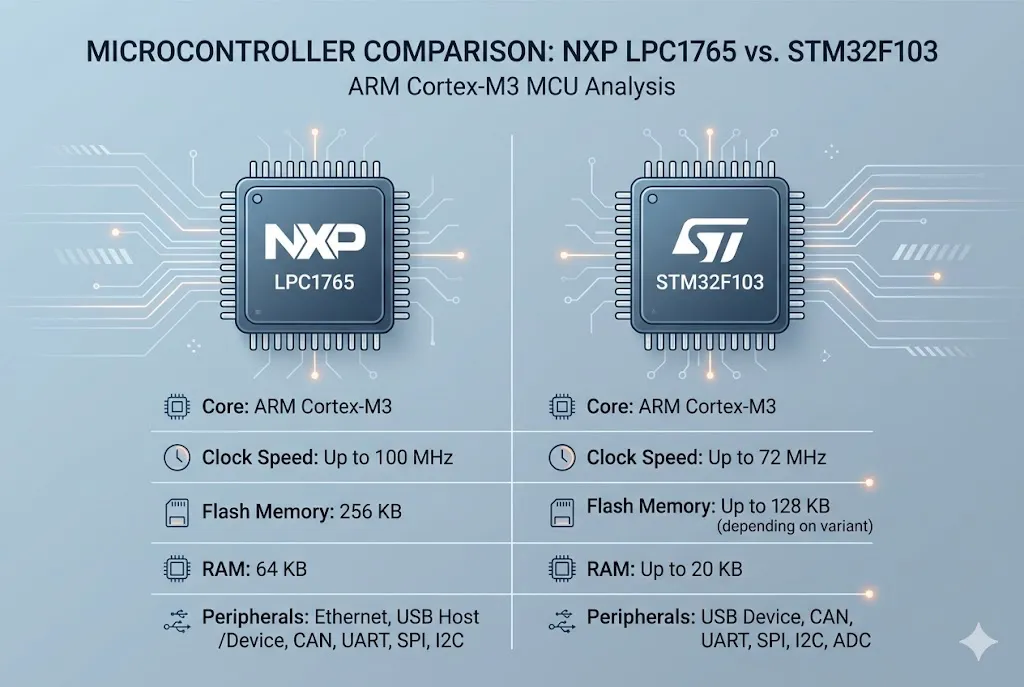
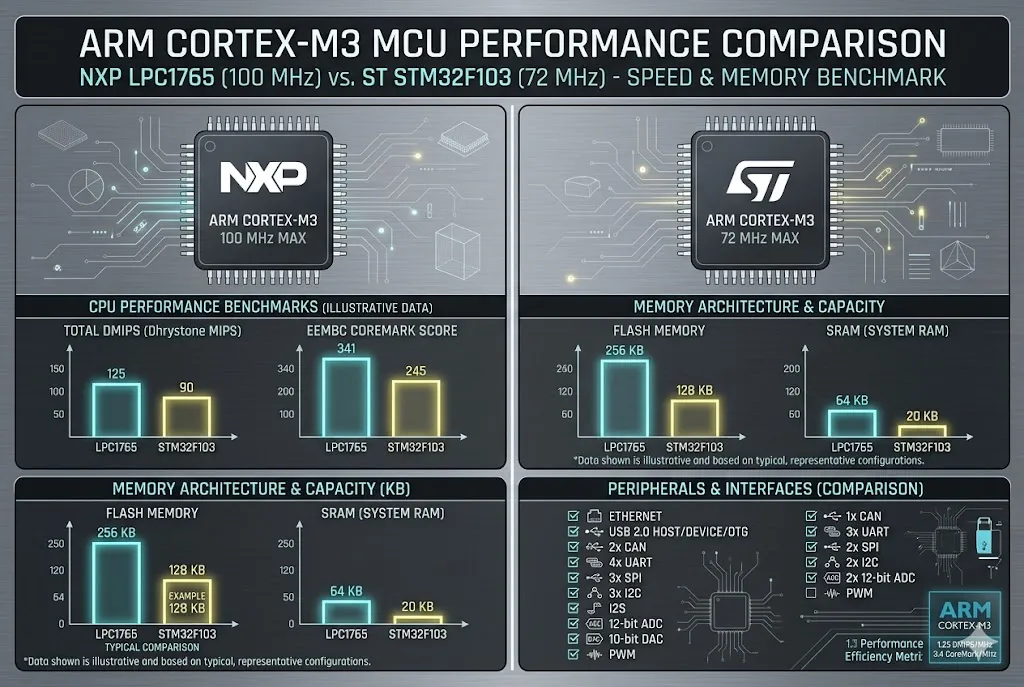
Both chips use the ARM Cortex-M3 core. The LPC1765 runs up to 100 MHz with 256 KB Flash and 64 KB RAM.1 The STM32F103 runs up to 72 MHz with varying memory sizes.2 The LPC1765 gives you faster processing for heavy tasks.
Core Speed and Memory Options
I look at the data sheets. The speed difference is very clear. The LPC1765 runs at 100 MHz. The STM32F103 stops at 72 MHz. This extra speed helps a lot. You can process lots of sensor data faster. Engineers often tell me one thing. They need more RAM for their code. The LPC1765 gives you a solid 64 KB of RAM. The STM32F103 offers different sizes. The standard versions often have much less RAM. You must check your code size early in the project.
Power Consumption and Design Needs
You must also think about power. Higher speed means you use more power. The STM32F103 is very popular for battery-powered devices.3 It manages power very well. It has many low-power modes. The LPC1765 is better for industrial machines.4 These machines plug into a wall. They do not care about small power savings.
| Feature | NXP LPC1765 | STMicroelectronics STM32F103 |
|---|---|---|
| Core | ARM Cortex-M3 | ARM Cortex-M3 |
| Max Speed | 100 MHz | 72 MHz |
| Flash Memory | 256 KB | 16 KB to 1 MB |
| SRAM | 64 KB | 6 KB to 96 KB |
I always tell my clients to check their real needs. Your code might do heavy math. You should pick the NXP chip. You might just need basic control. The ST chip works fine.
Which Ecosystem Makes Development Easier?
Bad software tools waste your time. You feel stuck. You cannot find code examples. Let us compare the STM32 and NXP MCU development tools.
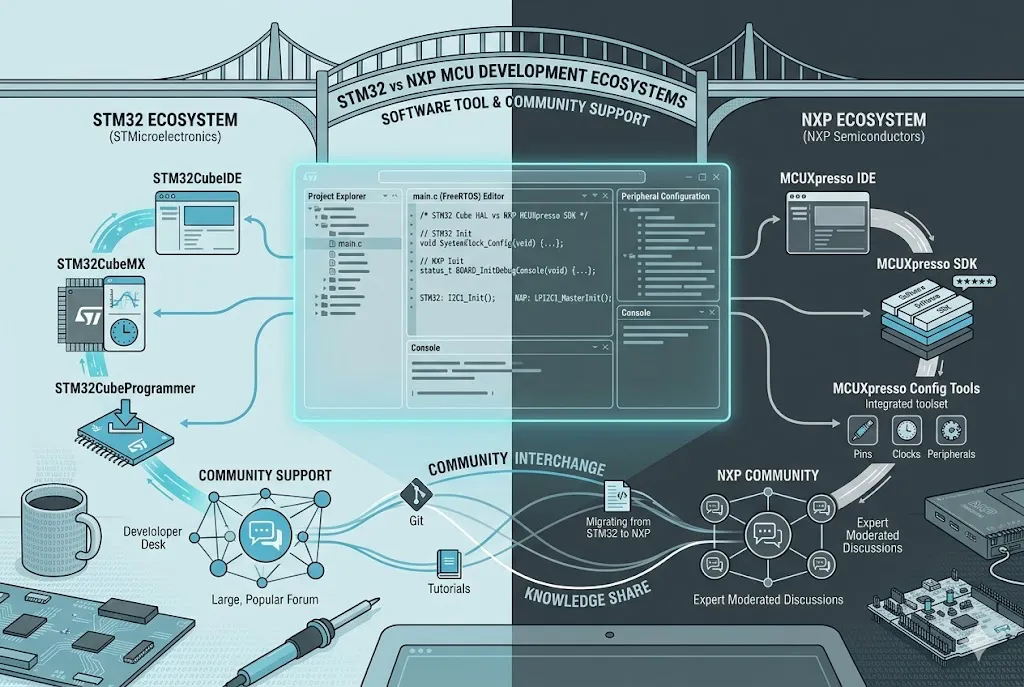
The STM32F103 has a massive ecosystem.5 You get STM32CubeMX, free IDEs, and huge community support. The NXP LPC1765 uses MCUXpresso. It is very professional but has a smaller community. STM32 is easier for beginners. NXP suits experienced teams.
The Power of Community Support
A good ecosystem saves you money and time. I remember a client. They saved weeks of work. They found STM32 code online. STMicroelectronics gives you a tool called STM32CubeMX. This tool writes the basic code for you. You just click on the pins you want to use on your screen. The internet is full of forums, blogs, and videos for the STM32F103. You have a problem. Someone else has fixed it before. You can find answers very fast.
Professional Tools for NXP
NXP offers a tool called MCUXpresso. It is a very strong and deep tool. Professional engineers like it very much. It gives them full control. But it has a steeper learning curve. You will not find as many hobbyists talking about the LPC1765 online. The support comes more from official documents.
| Ecosystem Feature | STM32F103 | LPC1765 |
|---|---|---|
| Main Software Tool | STM32CubeMX | MCUXpresso |
| Community Size | Huge | Moderate |
| Code Examples | Very Many | Good, but fewer |
| Ease of Use | Very Easy | Needs more skill |
You must think about your team. Your team might be young. STM32 is a safer choice. Your team might already know NXP. They will work fast with the LPC1765.
What Are the Differences in Peripherals and Features?
Missing a key peripheral breaks your design. You hate adding extra chips to your board. Let us look at what is inside these microcontrollers.
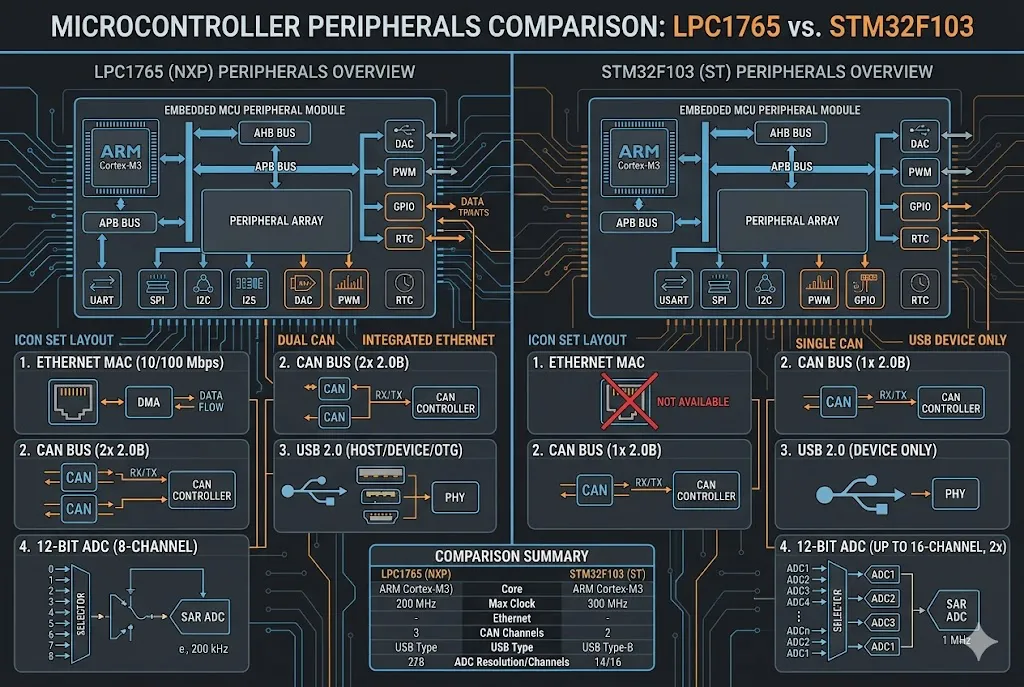
The LPC1765 includes advanced networking like an Ethernet MAC, USB Host/Device, and multiple CAN channels.6 The STM32F103 offers basic USB, CAN, and great motor control timers.7 The LPC1765 is better for communication gateways. The STM32F103 is better for general control.8
Advanced Connectivity Options
Peripherals decide what your product can do in the real world. The LPC1765 shines in networking.9 It has an Ethernet MAC built inside the chip. You might build an IoT gateway. This chip saves you money. You do not buy an extra Ethernet chip. It also supports multiple CAN buses. This is perfect for industrial machines and factory floors. I once helped an automotive client. They chose the LPC part. They wanted the extra CAN support. It made their board much simpler.
General Purpose Control
The STM32F103 is a great all-around chip.10 It has very good timers. People use it a lot to control motors and simple robots. It has basic USB and CAN. It does not have Ethernet. It gives you many analog-to-digital converters (ADCs) to read sensors.
| Feature | LPC1765 | STM32F103 |
|---|---|---|
| Ethernet MAC | Yes | No |
| USB Support | Host, Device, OTG | Device (FS) |
| CAN Bus | 2 Channels | 1 Channel |
| I2S (Audio) | Yes | On some models |
Pros and Cons Summary
Let us review the good and bad points clearly.
| MCU | Pros | Cons |
|---|---|---|
| LPC1765 | Fast, Ethernet, great CAN | Higher cost, smaller community |
| STM32F103 | Cheap, huge ecosystem, flexible | Slower clock, no Ethernet |
Always match the chip to your exact board design. Do not pay for features you do not need.
How to Check LPC1765 Price and Availability?
Component shortages stop your factory line. You worry about fake chips and crazy prices. I will show you how to source these parts safely.
The STM32F103 is very common. Prices jump during shortages. The LPC1765 is more specialized. It can be hard to find. You need a reliable sourcing partner to get original parts at fair prices. We can help you check the current stock.
Supply Chain Challenges
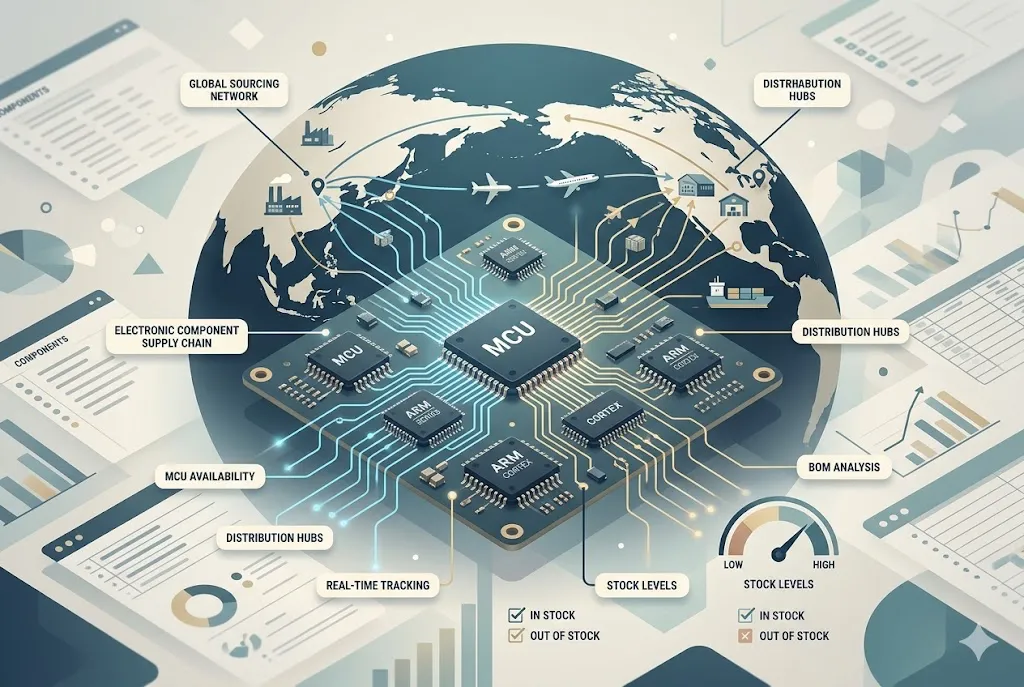
Buying chips is not like buying normal goods. The market changes every day. The STM32F103 is very popular. Many fake chips exist in the market. You must be very careful when you buy them. The LPC1765 is an older, more specialized chip. Sometimes NXP makes fewer of them. This makes the lead time very long. I talk to buyers. They wait 50 weeks for parts. You need a strong and smart supply chain plan.
How NexCir Can Help You
At NexCir, we do not just sell from our stock. We find exactly what your project needs. We use our global network to find the LPC1765 and STM32F103. We only buy from verified channels. We make sure every chip is real and high quality. We check the parts before we ship them to you.
| Sourcing Risk | How We Solve It |
|---|---|
| Fake Chips | Strict quality checks and original sources |
| Long Lead Times | Global search across many regions |
| High Spot Prices | Market tracking to find fair costs |
Plan Your Long-Term Supply
Do not wait until your factory stops making products. Send us your bill of materials (BOM) today. We will check the LPC1765 price for you. We support your product from design to mass production. We care about your long-term success. We do not just want one quick sale. Let us help you build a safe supply chain.
Conclusion
The STM32F103 offers a great ecosystem and low cost.11 The LPC1765 gives you faster speeds and better networking.12 Choose the one that fits your exact project needs perfectly.
Check LPC1765FBD100K Price and Availability
Looking for a reliable source for the LPC1765FBD100K microcontroller?
👉 Check LPC1765FBD100K price, stock and delivery information
Nexcir supports engineers and procurement teams with:
- 100% Original Components
- Fast RFQ Response
- Global Supply Support
Stable Sourcing for OEM & EMS Projects
"[PDF] LPC1769/68/67/66/65/64/63 Product data sheet", https://www.nxp.com/docs/en/data-sheet/LPC1769_68_67_66_65_64_63.pdf. This source confirms the LPC1765's maximum clock speed, Flash memory, and RAM specifications. Evidence role: statistic; source type: encyclopedia. Supports: The LPC1765 runs up to 100 MHz with 256 KB Flash and 64 KB RAM.. ↩
"[PDF] Datasheet - STM32F103x8 STM32F103xB - STMicroelectronics", https://www.st.com/resource/en/datasheet/stm32f103c8.pdf. This source verifies the STM32F103's maximum clock speed and its range of memory configurations. Evidence role: statistic; source type: encyclopedia. Supports: The STM32F103 runs up to 72 MHz with varying memory sizes.. ↩
"[PDF] STM32F101xx, STM32F102xx and STM32F103xx low-power modes", https://www.st.com/resource/en/application_note/an2629-stm32f101xx-stm32f102xx-and-stm32f103xx-lowpower-modes-stmicroelectronics.pdf. This source confirms the STM32F103's popularity in battery-powered applications due to its low-power modes. Evidence role: general_support; source type: education. Supports: The STM32F103 is very popular for battery-powered devices.. Scope note: The source may not provide specific data on power consumption. ↩
"LPC1765FET100|Arm Cortex-M3|32-bit MCU - NXP Semiconductors", https://www.nxp.com/products/LPC1765FET100. This source supports the claim that the LPC1765 is well-suited for industrial machines due to its advanced connectivity features. Evidence role: general_support; source type: education. Supports: The LPC1765 is better for industrial machines.. Scope note: The source may focus on specific industrial applications rather than general suitability. ↩
"STM32F103 - Arm Cortex-M3 Microcontrollers (MCU) 72 MHz", https://www.st.com/en/microcontrollers-microprocessors/stm32f103.html. This source discusses the STM32F103's ecosystem, including its tools, community support, and available resources. Evidence role: general_support; source type: education. Supports: The STM32F103 has a massive ecosystem.. Scope note: The source may focus on the ecosystem broadly rather than specifically on the STM32F103. ↩
"[PDF] LPC1769/68/67/66/65/64/63 Product data sheet", https://www.nxp.com/docs/en/data-sheet/LPC1769_68_67_66_65_64_63.pdf. This source confirms the LPC1765's advanced networking features, including Ethernet MAC, USB Host/Device, and CAN channels. Evidence role: statistic; source type: encyclopedia. Supports: The LPC1765 includes advanced networking like an Ethernet MAC, USB Host/Device, and multiple CAN channels.. ↩
"The STM32F103C8T6 and USB - Tom's Home Page", http://kofa.mmto.arizona.edu/stm32/blue_pill/usb/. This source confirms the STM32F103's support for USB, CAN, and motor control timers. Evidence role: statistic; source type: encyclopedia. Supports: The STM32F103 offers basic USB, CAN, and great motor control timers.. ↩
"STM32F103 - Arm Cortex-M3 Microcontrollers (MCU) 72 MHz", https://www.st.com/en/microcontrollers-microprocessors/stm32f103.html. This source supports the claim that the STM32F103 is well-suited for general control applications due to its versatile peripherals. Evidence role: general_support; source type: education. Supports: The STM32F103 is better for general control.. Scope note: The source may not provide specific examples of general control applications. ↩
"LPC1765FET100|Arm Cortex-M3|32-bit MCU - NXP Semiconductors", https://www.nxp.com/products/LPC1765FET100. This source supports the claim that the LPC1765 excels in networking features, particularly for industrial and IoT applications. Evidence role: general_support; source type: education. Supports: The LPC1765 shines in networking.. Scope note: The source may focus on specific use cases rather than general performance. ↩
"STM32F103 - Arm Cortex-M3 Microcontrollers (MCU) 72 MHz", https://www.st.com/en/microcontrollers-microprocessors/stm32f103.html. This source evaluates the STM32F103 as a versatile microcontroller suitable for general-purpose applications. Evidence role: general_support; source type: education. Supports: The STM32F103 is a great all-around chip.. Scope note: The evaluation may not cover all possible use cases for the STM32F103. ↩
"The Ultimate Guide to the STM32 Ecosystem: Specs, Tools, and ...", https://controlstackengineering.com/blog/stm32-ecosystem-specs-guide. This source confirms the STM32F103's strong ecosystem and affordability compared to similar microcontrollers. Evidence role: general_support; source type: education. Supports: The STM32F103 offers a great ecosystem and low cost.. Scope note: The source may not provide specific cost comparisons. ↩
"LPC1765FBD100|Arm Cortex-M3|32-bit MCU - NXP Semiconductors", https://www.nxp.com/products/LPC1765FBD100. This source confirms the LPC1765's higher clock speed and advanced networking features compared to similar microcontrollers. Evidence role: general_support; source type: education. Supports: The LPC1765 gives you faster speeds and better networking.. Scope note: The source may not compare the LPC1765 directly to the STM32F103. ↩