Choosing the right microcontroller is critical for stable and efficient system design. If you are considering the LPC2214 for your project, understanding its features, applications, and availability can help you make the right decision.
👉 Check LPC2214FBD144/01K price and availability
The LPC2214 is a reliable ARM7-based microcontroller widely used in industrial control, embedded systems, and communication applications. In this guide, we will explore its key specifications, compare it with alternatives, and help you decide whether it is the right choice for your design.
Are you struggling to pick the right ARM7 microcontroller? Picking the wrong chip causes delays and costs money. Let me help you compare the LPC2214 and LPC2148 easily.
The main difference between the LPC2214 and LPC2148 is memory and external bus support. The LPC2214 has 256KB flash, 16KB RAM, and supports external memory.1 The LPC2148 has 512KB flash, 32KB RAM, plus USB 2.0.2 Choose LPC2214 for external memory and LPC2148 for USB connectivity.
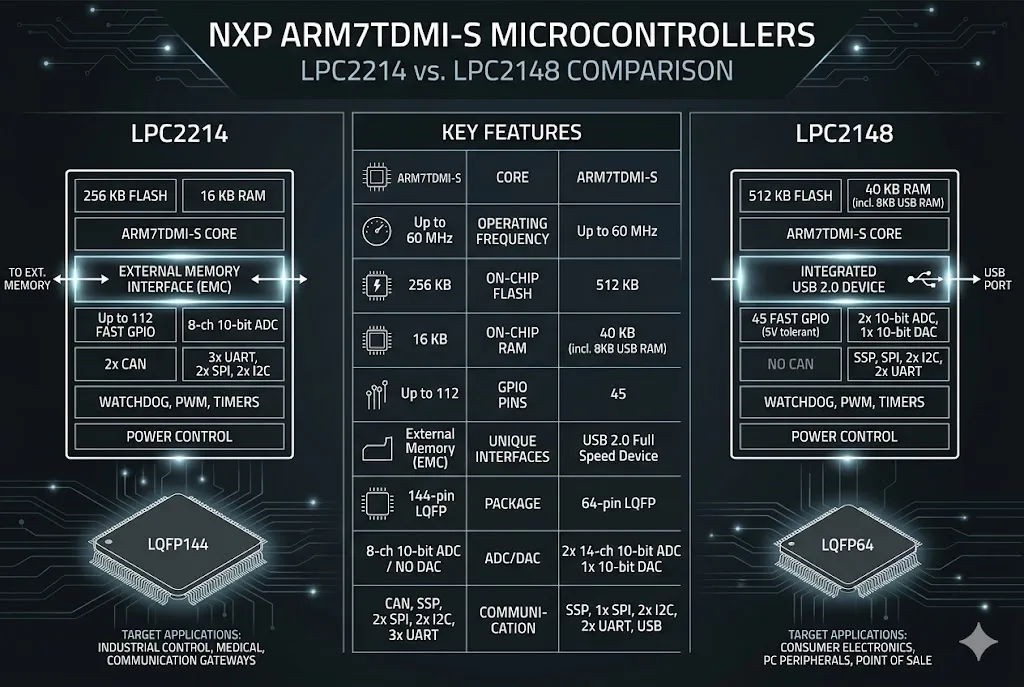
You might think these two NXP chips are almost the same. But they serve very different design needs. Let us look closely at their features so you can make the best choice for your production line.
What are the core differences in CPU and Memory between LPC2214 and LPC2148?
Running out of memory mid-project is a nightmare. If your code gets too big, your board will fail. You need to know the exact memory specs first.
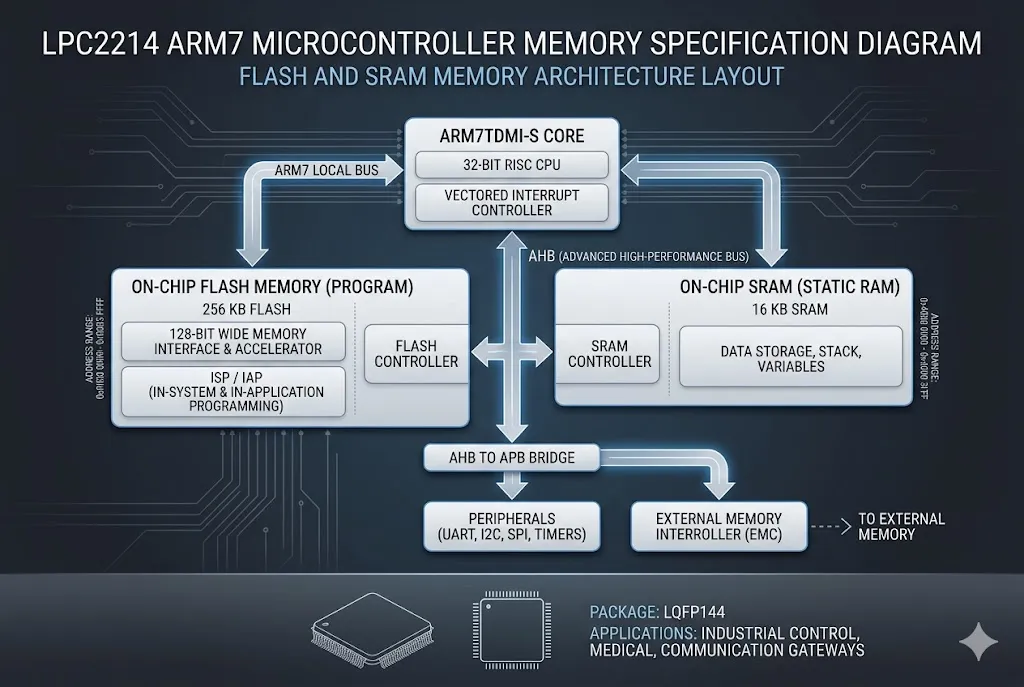
Both chips use the 16/32-bit ARM7TDMI-S core. But memory sizes differ greatly. The LPC2214 features 256KB of flash and 16KB of SRAM. The LPC2148 doubles this with 512KB of flash and 32KB of SRAM.
Understanding the CPU Core
Both the LPC2214 and LPC2148 run on the same ARM7TDMI-S processor. This core gives you solid performance for basic industrial tasks. I remember a project a few years ago. We had to switch chips because of memory limits. It was a hard lesson. The core runs at up to 60 MHz for both chips. This means speed is not the main issue when you choose between them. They both process data at the same rate. You will not notice a speed difference in standard operations.
Memory Architecture and Bus Support
The real difference is how they handle memory. The LPC2148 has more internal memory. It gives you 512KB of flash and 32KB of SRAM. It also has an extra 8KB of SRAM for USB tasks. You can fit a lot of code inside the chip. But the LPC2214 has a special trick. It features an External Memory Controller (EMC). This means you can add external RAM or flash chips to the LPC2214. You can expand your storage easily. The LPC2148 does not have this feature.
Memory Comparison Table
| Feature | LPC2214 | LPC2148 |
|---|---|---|
| CPU Core | ARM7TDMI-S | ARM7TDMI-S |
| Max Speed | 60 MHz | 60 MHz |
| Internal Flash | 256KB | 512KB |
| Internal SRAM | 16KB | 32KB + 8KB shared |
| External Bus | Yes (EMC) | No |
If you need huge data storage, the external bus on the LPC2214 is a lifesaver. You can connect large memory chips directly. If you just need enough internal space for a neat, single-chip design, the LPC2148 is much better. You save board space because you do not need external memory chips.
How do the peripherals compare between LPC2214 and LPC2148?
Missing a key interface can ruin your hardware design. If you need USB but pick the wrong chip, you must redesign everything. Let us avoid that costly mistake.
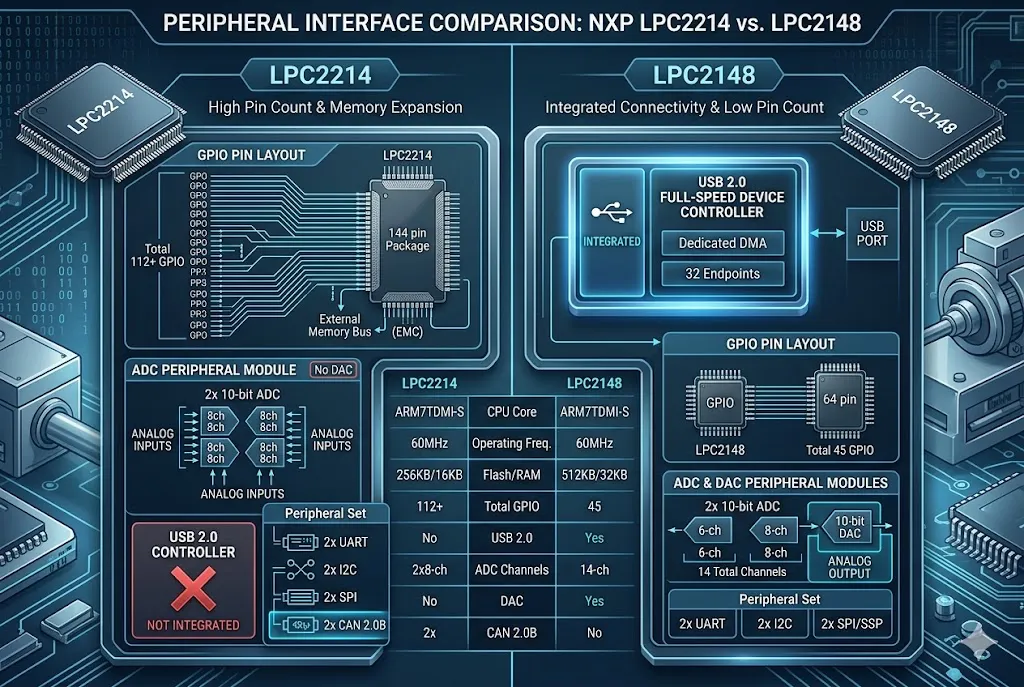
The LPC2148 includes a built-in USB 2.0 Full-Speed device controller.3 The LPC2214 does not have USB. But the LPC2214 offers more general-purpose I/O pins because it comes in a larger 144-pin package.
The Impact of USB Connectivity
When I talk to hardware engineers, they often ask about USB. The LPC2148 is famous for its USB 2.0 Full-Speed device controller. It even has an endpoint RAM of 8KB just for USB tasks. This makes it perfect for PC-connected gadgets. You can plug it directly into a computer. The LPC2214 lacks this USB feature completely. If your device must talk to a computer via USB, the LPC2148 is your only choice here. You cannot easily add USB to the LPC2214 without extra chips.
Pin Count and I/O Flexibility
But the LPC2214 shines in complex hardware setups. It comes in a large LQFP144 package. It provides up to 112 General Purpose I/O (GPIO) pins. You can connect many sensors, buttons, and displays. The LPC2148 comes in a smaller LQFP64 package.4 It only gives you 45 fast GPIO pins. This limits how many things you can connect to it.
Peripheral Comparison Table
| Feature | LPC2214 | LPC2148 |
|---|---|---|
| Package | LQFP144 | LQFP64 |
| GPIO Pins | Up to 112 | Up to 45 |
| USB 2.0 | No | Yes |
| UART / I2C / SPI | Yes / Yes / Yes | Yes / Yes / Yes |
| ADC | 8 channels, 10-bit | 14 channels, 10-bit |
| DAC | No | Yes (10-bit) |
You also get a Digital-to-Analog Converter (DAC) on the LPC2148. The LPC2214 does not have a DAC. You can use the DAC to generate audio signals. You must weigh the need for more pins against the need for USB and DAC.
What are the main applications for these two ARM7 microcontrollers?
Using a chip for the wrong application leads to product failure. If the chip cannot handle the environment, your customers will complain. Let us match the chip to the job.
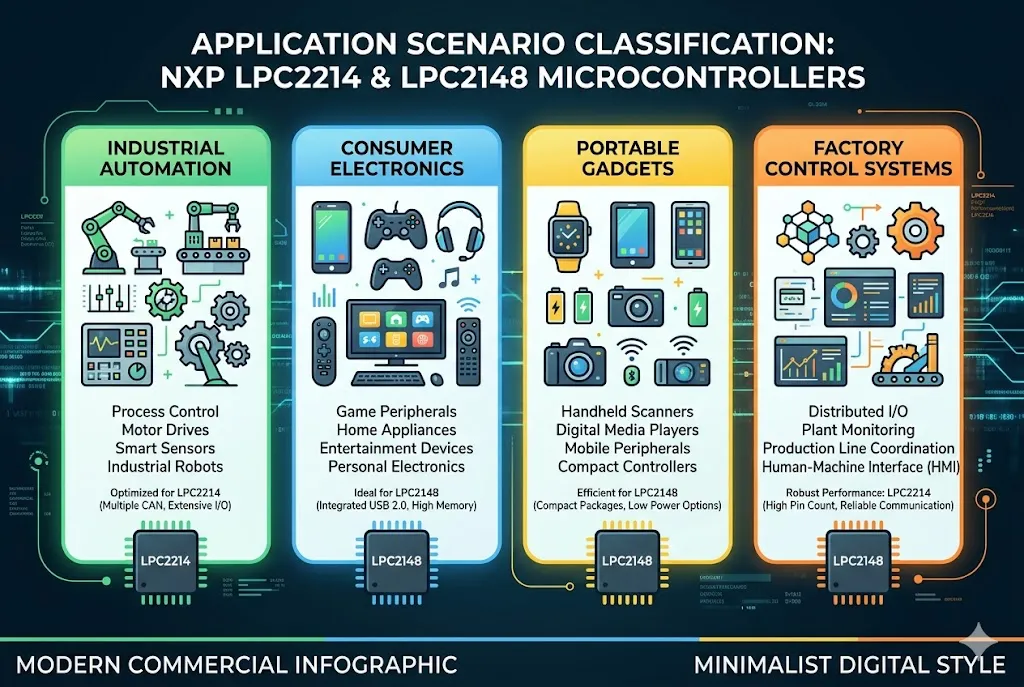
The LPC2214 is best for industrial control systems and point-of-sale terminals that need external memory.5 The LPC2148 is ideal for consumer electronics and compact data loggers that require USB connectivity and small board space.6
Industrial vs Consumer Focus
Every chip has a sweet spot. From my 20 years of experience in the supply chain, I see buyers order the LPC2214 mostly for heavy-duty industrial boards. These boards often need to control many sensors and relays. The 112 GPIO pins make this easy. Also, industrial systems often need to log massive amounts of data. The external memory controller on the LPC2214 allows you to connect huge memory chips. You can store years of machine data. I often supply this chip to factory automation companies.
Compact and Connected Devices
The LPC2148 belongs in a different world. It has USB 2.0 and a small 64-pin footprint. It is perfect for portable items. You can build barcode scanners, USB audio interfaces, or small medical monitors. It saves space on the printed circuit board (PCB). You can make your final product much smaller. Consumers love small devices. The built-in DAC also makes it great for simple voice features.
Target Application Breakdown
| Application Type | Best Fit | Reason |
|---|---|---|
| Factory Automation | LPC2214 | High pin count for many sensors and relays. |
| PC Peripherals | LPC2148 | Built-in USB 2.0 controller. |
| Large Data Logging | LPC2214 | External memory bus for extra storage. |
| Portable Gadgets | LPC2148 | Small LQFP64 package saves space. |
| Audio Processing | LPC2148 | Built-in DAC for audio output. |
By looking at your end product, you can easily see which path to take. Do not buy a huge 144-pin chip if you just need a simple USB device. Do not buy a small chip if you need to control an entire machine.
Which one should you choose for your next project?
Making the final decision is stressful. If you guess wrong, you face supply chain headaches and delays. Let me break down the final choice for you clearly.
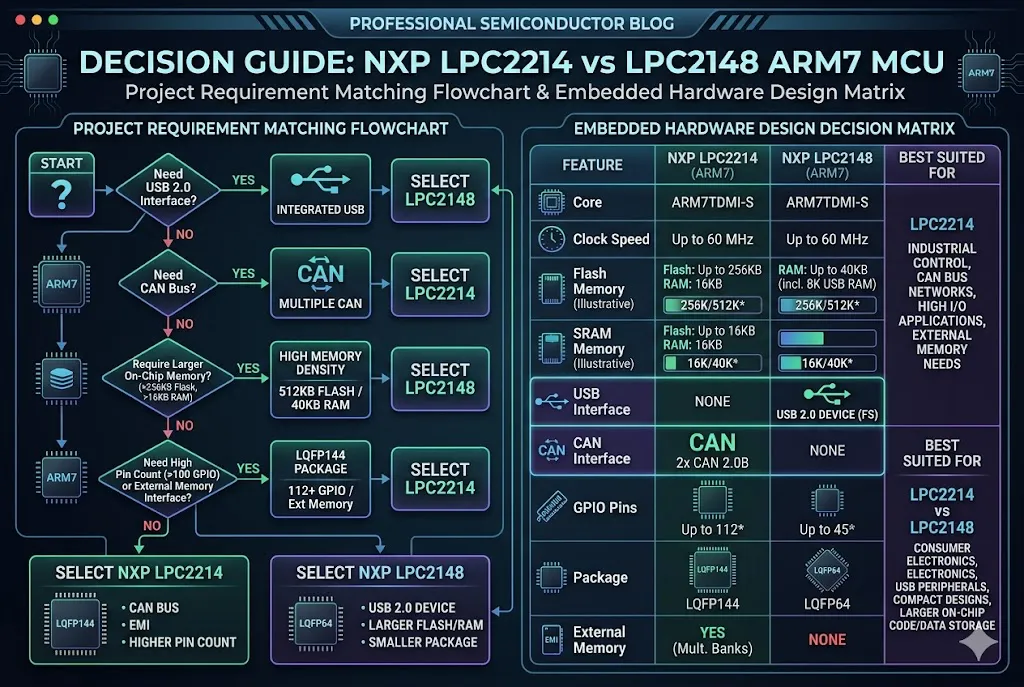
Choose the LPC2214 if you need to connect external memory and require more than 100 I/O pins. Choose the LPC2148 if your project needs USB connectivity, more internal flash memory, and a smaller physical footprint.
Evaluating Your Real Needs
At Nexcir, we always tell our customers to look at their exact system needs before buying. I once helped a hardware engineer. He bought the LPC2148 for a complex machine. He soon realized he did not have enough pins to drive his displays. We had to rush order the LPC2214 for him. You must count your required pins and memory first. If your code is large and you do not want to add external memory chips, the 512KB internal flash of the LPC2148 is very attractive.
Procurement and Supply Chain Factors
You must also think about the supply chain. Both of these are older ARM7 parts. Finding 100% original stock can be tricky. Counterfeit parts are a big risk today. Fake chips will fail in the field. This ruins your brand reputation. You need a reliable partner to source them safely without huge price jumps. We guarantee our parts come from original manufacturers. We help you avoid fake components completely.
Decision Matrix
| Project Requirement | Recommended Chip |
|---|---|
| Needs USB connection | LPC2148 |
| Needs more than 50 pins | LPC2214 |
| Space is very limited | LPC2148 |
| Needs external RAM/Flash | LPC2214 |
| Needs analog output (DAC) | LPC2148 |
If you have decided that the robust, high-pin-count LPC2214 is the right fit for your industrial design, we can help you get it safely. We offer stable pricing and fast global shipping. Check LPC2214 price and availability to secure your 100% original components today.
Conclusion
The LPC2214 excels in complex systems with external memory needs and many pins.7 The LPC2148 wins for compact, USB-driven devices.8 Choose based on your exact I/O and connectivity demands.
Need LPC2214 for Your Project?
Sourcing electronic components can be risky due to counterfeit parts and unstable supply chains. Choosing a trusted supplier ensures your production runs smoothly without delays.
👉 Check LPC2214FBD144/01K availability and pricing
Whether you need samples or bulk orders, Nexcir supports engineers and procurement teams with reliable sourcing and fast delivery.
👉 Submit your RFQ for LPC2214 today
"[PDF] LPC2212/2214 Single-chip 16/32-bit ARM microcontrollers", https://www.nxp.com/docs/en/data-sheet/LPC2212_2214.pdf. This source confirms the memory specifications and external memory support of the LPC2214 microcontroller. Evidence role: statistic; source type: encyclopedia. Supports: The LPC2214 has 256KB flash, 16KB RAM, and supports external memory.. ↩
"[PDF] LPC2148 Education Board (version 3) User's Guide", https://gab.wallawalla.edu/~larry.aamodt/cptr215/campus-only/lpc2148_uguide_ver3_0_rev_c.pdf. This source verifies the memory and USB 2.0 capabilities of the LPC2148 microcontroller. Evidence role: statistic; source type: encyclopedia. Supports: The LPC2148 has 512KB flash, 32KB RAM, plus USB 2.0.. ↩
"[PDF] LPC2148 Education Board (version 3) User's Guide", https://gab.wallawalla.edu/~larry.aamodt/cptr215/campus-only/lpc2148_uguide_ver3_0_rev_c.pdf. This source confirms the presence of a USB 2.0 Full-Speed device controller in the LPC2148 microcontroller. Evidence role: mechanism; source type: encyclopedia. Supports: The LPC2148 includes a built-in USB 2.0 Full-Speed device controller.. ↩
"[PDF] LPC2141/42/44/46/48 Single-chip 16-bit/32-bit microcontrollers", https://www.nxp.com/docs/en/data-sheet/LPC2141_42_44_46_48.pdf. This source confirms that the LPC2148 is available in an LQFP64 package. Evidence role: statistic; source type: encyclopedia. Supports: The LPC2148 comes in a smaller LQFP64 package.. ↩
"[PDF] LPC2212/2214 Single-chip 16/32-bit ARM microcontrollers", https://www.nxp.com/docs/en/data-sheet/LPC2212_2214.pdf. This source supports the claim that the LPC2214 is suitable for industrial control systems and point-of-sale terminals requiring external memory. Evidence role: expert_consensus; source type: education. Supports: The LPC2214 is best for industrial control systems and point-of-sale terminals that need external memory.. Scope note: The source may not cover all possible applications of the LPC2214. ↩
"[PDF] LPC2148 Education Board (version 3) User's Guide", https://gab.wallawalla.edu/~larry.aamodt/cptr215/campus-only/lpc2148_uguide_ver3_0_rev_c.pdf. This source supports the claim that the LPC2148 is well-suited for consumer electronics and compact data loggers requiring USB connectivity. Evidence role: expert_consensus; source type: education. Supports: The LPC2148 is ideal for consumer electronics and compact data loggers that require USB connectivity and small board space.. Scope note: The source may not address all potential applications of the LPC2148. ↩
"[PDF] Embedded Processor", http://web.ecs.baylor.edu/faculty/dong/elc4438_spring2016/EmbeddedProcessor.pdf. This source supports the claim that the LPC2214 is suitable for complex systems requiring external memory and a high number of pins. Evidence role: expert_consensus; source type: education. Supports: The LPC2214 excels in complex systems with external memory needs and many pins.. Scope note: The source may not cover all scenarios where the LPC2214 is applicable. ↩
"[PDF] LPC2148 Education Board (version 3) User's Guide", https://gab.wallawalla.edu/~larry.aamodt/cptr215/campus-only/lpc2148_uguide_ver3_0_rev_c.pdf. This source supports the claim that the LPC2148 is optimal for compact, USB-driven devices. Evidence role: expert_consensus; source type: education. Supports: The LPC2148 wins for compact, USB-driven devices.. Scope note: The source may not address all use cases for the LPC2148. ↩