A4447SLJTR-T at a Glance: The Documented Parameter Set
This guide sets out every parameter NexCir holds for the A4447SLJTR-T in one place, so a purchasing team can screen the part against a design brief before committing to a full datasheet review. The table below is the complete documented set — seven items, nothing inferred.
| Parameter | Documented value |
|---|---|
| Operating voltage | 8 to 50 V |
| Output voltage | 0.8 to 24 V |
| Output current | 2 A |
| Quiescent current | 100 µA |
| Package | 8 Pin SOIC |
| Pin count | 8 |
| Operating temperature | –20 to 85 °C |
Read the table as a screening tool, not as a specification. Anything not listed here is outside this record, and that includes the test conditions behind each figure. Where a design depends on a number that does not appear above, the datasheet is the place to settle it — do not assume a value because the listed ones look familiar.
The rest of this guide takes each row in turn and explains what it decides for a buyer.
Operating Voltage: 8 to 50 V
The documented operating voltage is 8 to 50 V. For most buyers this is the first screen, because the rail that feeds the device has to sit inside that window at both ends of its tolerance. A rail whose worst-case low drifts below the lower limit, or whose worst-case high climbs past the upper limit, falls outside the documented range even when its nominal value looks comfortable.
The window is also the reference point for the components specified around the device. Input capacitors, connectors and any series element on the feed path must be rated for the same span, and it is cheaper to check that during schematic review than after a layout is released.
One caution: the record gives a single operating window. It does not separate absolute maximum ratings, transient limits or start-up behaviour, so a design exposed to surges or hot-plug events needs those figures confirmed from the datasheet before the rail is signed off.
Output Voltage 0.8 to 24 V and Output Current 2 A
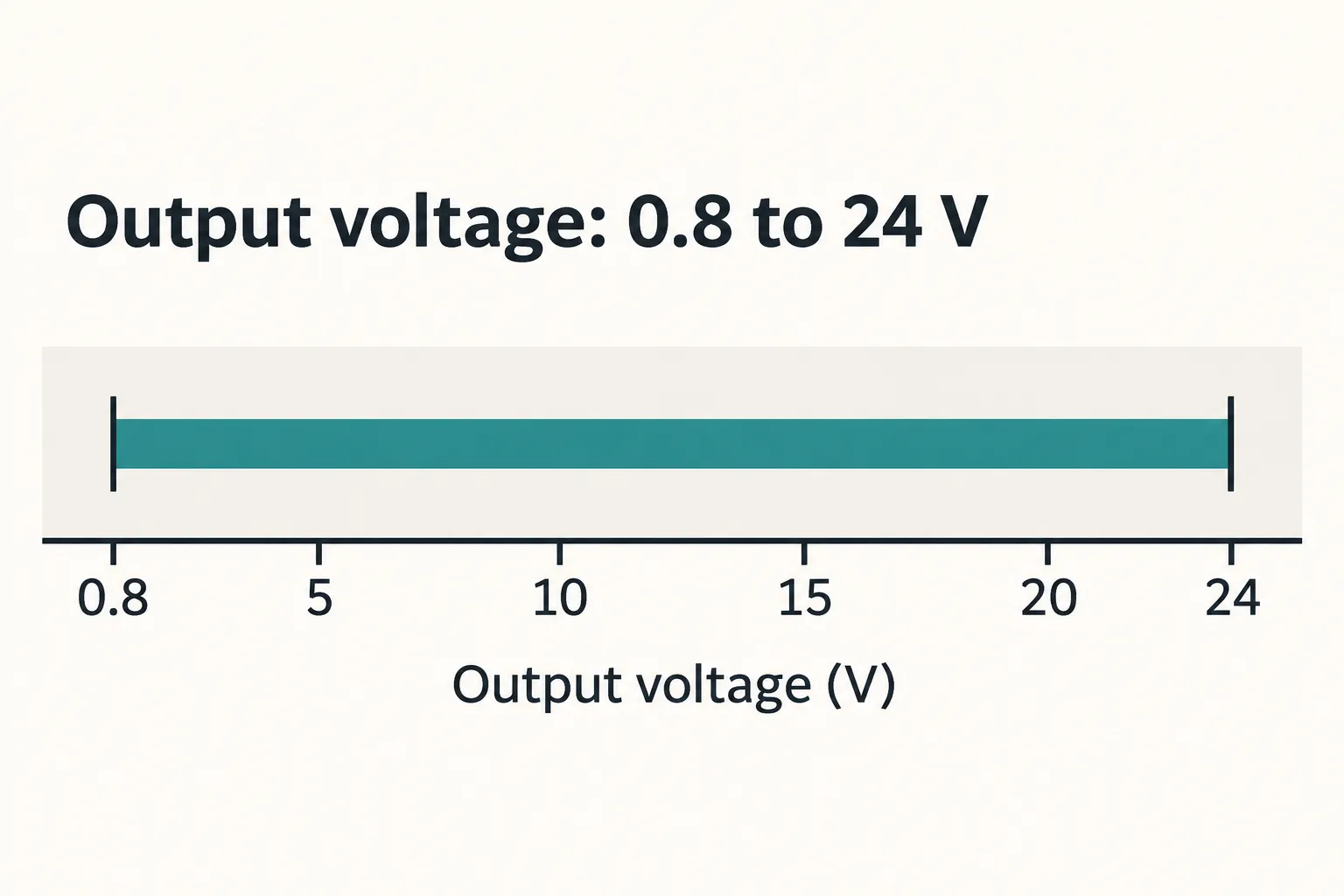
The documented output voltage is 0.8 to 24 V and the documented output current is 2 A. These two numbers answer the questions an engineer asks first: can the required setpoint be reached inside the window, and can the load be carried within the current figure?
The setpoint check is straightforward — the regulated voltage the design needs must fall inside 0.8 to 24 V. The current check needs a little more care, because the record states 2 A as a single figure without conditions attached. It does not say at which ambient temperature, copper area, airflow or duty cycle that figure applies. A design that draws close to the documented current should therefore confirm the conditions behind the number before the thermal side of the layout is fixed.
For procurement, the pair is useful in a different way: it defines the class of load the part is documented to serve, which makes it easier to compare a requirement against what NexCir can actually quote from the record rather than from a competitor's summary table.
Quiescent Current: 100 µA
The documented quiescent current is 100 µA. This is the current the device itself accounts for — the line item a standby or always-on power budget has to carry before any load current is added.
On its own, 100 µA is a small number. What matters is how many devices sit on the same always-on rail and how the budget is written. A buyer comparing the documented figure against a system allowance can settle that question early, at the block-diagram stage, rather than discovering it when the standby measurement comes in over target.
The record gives one value and does not state the conditions under which it was taken — supply voltage, temperature, output state or mode. Where the budget is tight, ask for those conditions explicitly instead of treating 100 µA as a guaranteed ceiling in every operating state.
Package and Pin Count: 8 Pin SOIC
The documented package is an 8 Pin SOIC and the documented pin count is 8. The two agree, which is the first thing a layout or goods-in team checks: a package name and a pin count that contradict each other are a warning sign in any part record.
For layout, the package name is the input to the land pattern, the stencil apertures and the inspection plan. Because the pin count is fixed at 8, the footprint has no spare positions — there is no room to rework a net onto an unused pin, so the schematic and the board have to agree before the first article is built.
For goods-in, an 8 Pin SOIC body is small enough that the inspection is normally done on the bench under magnification. The record does not state a packing format, so confirm how the parts are presented when you place an order; that detail affects how receiving and the line handle them.

Operating Temperature Range: –20 to 85 °C
The documented operating temperature range is –20 to 85 °C. Buyers should compare this with the air temperature the board will actually see — not the room temperature on the day of the test, but the coldest and warmest conditions the equipment meets through the year, including any heat that builds up around the board inside its enclosure.
Both ends of the range matter. A product shipped or stored in an unheated space, or one that starts up on a cold morning, tests the lower end; an enclosure that traps heat from neighbouring components tests the upper end. If the application environment falls outside –20 to 85 °C, this part is outside its documented range for that use, whatever the nominal conditions suggest.
Note that the record gives one operating range only. It does not state storage limits or junction temperature figures, so those need separate confirmation rather than being read across from the operating range.
How to Request a Quote
If the documented parameters fit your design, NexCir can prepare a quotation against your requirement. It helps to send the quantity you are planning, the supply rail and load conditions of your application, the temperature environment the board will see, and any documentation you need alongside the parts. With those details in hand, we can match your request against the record set out above and respond with a quotation.