Medical scanners often need extreme cold1. This limits their use and raises costs. Diamond quantum sensors2 solve this. They work at room temperature3 to give clear results.
Diamond quantum sensors2 use tiny defects in diamond crystals, called nitrogen-vacancy centers4, to measure magnetic fields. They operate perfectly at room temperature3. This removes the need for bulky cooling systems5. Doctors use them to create highly accurate medical images without expensive equipment.
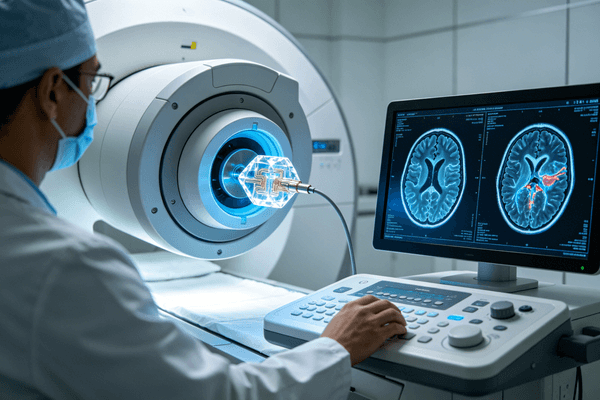
You might think quantum tech only belongs in giant labs. I used to think the same way. But let me show you how this technology is moving into standard hospital rooms right now.
How do diamond quantum sensors work at room temperature3?
Quantum devices usually fail when they get warm. This heat destroys sensitive data. Diamond sensors protect this data. Their strong crystal lattice keeps quantum states stable6 at room temperature3.
A diamond quantum sensor traps electrons inside a nitrogen-vacancy (NV) center. The rigid carbon structure of the diamond blocks outside heat and noise. This isolation allows the trapped electrons to measure tiny magnetic changes7 accurately, even in a warm room.

The Secret Inside the Crystal
I want to explain how this actually works. Regular quantum sensors use superconductors8. Superconductors must stay near absolute zero. If the temperature rises, the sensor stops working. This is a big problem for engineers. I see this issue often when customers ask me for special cooling components.
Diamonds are different. A diamond has a very tight carbon grid9. Sometimes, a nitrogen atom replaces a carbon atom. Right next to it, there is an empty space. We call this a nitrogen-vacancy (NV) center. This empty space holds electrons. The hard diamond grid acts like a thick wall. It protects the electrons from heat.
Comparing Sensor Technologies
Let us look at the differences. I made a simple table to compare these sensors.
| Feature | Superconducting Sensors | Diamond Quantum Sensors |
|---|---|---|
| Operating Temperature | Near absolute zero | Room temperature |
| Cooling Equipment | Large and expensive | Not needed |
| Size | Very bulky | Very small |
| Power Consumption | High | Low |
You can see why hardware engineers love diamonds. You do not need liquid helium. You do not need heavy pipes. The device becomes small and light. This changes how we design medical machines. We can build smaller scanners. Hospitals can save money and space.
Why do medical imaging systems need quantum precision?
Traditional MRI machines miss tiny details. Doctors struggle to see early signs of disease10. Quantum precision fixes this blind spot. It detects weak signals from individual cells clearly.
Medical imaging systems need quantum precision to map magnetic fields from the human brain and heart. Diamond quantum sensors2 detect these weak biological signals11 with extreme detail. Doctors use this data to find diseases earlier, track brain activity12, and improve patient care without using large MRI machines.
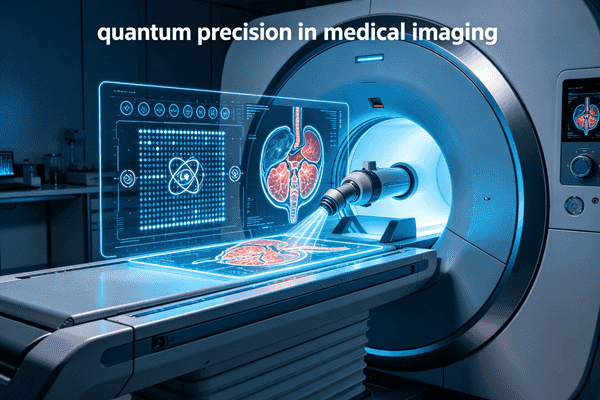
Catching the Weakest Signals
The human body creates small electrical currents. Your heart beats because of electricity. Your brain thinks because of electricity. These currents make tiny magnetic fields. Traditional sensors cannot measure them well. The signals are too weak. Background noise hides them.
I remember a chat with a medical device engineer last year. He told me his biggest headache. His team wanted to map brain waves. But standard sensors only picked up static noise. They needed something better. Diamond quantum sensors2 solve this problem. They can read the magnetic field of a single neuron.
How Doctors Use This Data
This high precision changes medical care. Let me break down the main uses.
| Medical Application | Traditional Method | Quantum Sensor Method |
|---|---|---|
| Brain Mapping (MEG) | Needs a heavy helmet and cooling | Uses a light, warm cap |
| Heart Scanning | Misses small rhythm changes | Detects exact cell signals |
| Cancer Detection | Finds large tumors | Finds early cell changes |
Doctors can now scan patients easily. The patient does not need to lie inside a loud, narrow tube. They can just wear a sensor patch. This is much better for children and sick people. It gives doctors better data to save lives.
What are the main challenges in manufacturing these sensors?
Making quantum diamonds is hard. Small mistakes ruin the sensor. Engineers waste time and money on bad batches. We must control the growing process perfectly to ensure quality.
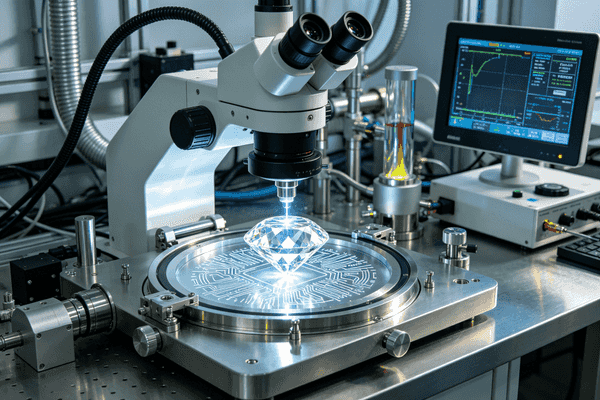
The main challenge in manufacturing diamond quantum sensors is creating perfect nitrogen-vacancy centers4. Engineers must grow synthetic diamonds in labs using extreme pressure and heat. They must place nitrogen atoms exactly right. Even a tiny impurity can destroy the quantum state and make the sensor useless.
The Trouble with Synthetic Growth
You cannot dig these diamonds out of the ground. Natural diamonds have too many flaws. We must make them in a lab. This process is very strict. We use a method called Chemical Vapor Deposition (CVD)13.
I have seen how hard this is. A production team needs perfect gases. They need exact temperatures. If the gas mix is wrong by one percent, the diamond fails. The nitrogen atoms must sit in the exact right spot. If they group together, the sensor breaks. This causes low yield rates14. Low yields mean high costs.
Supply Chain Roadblocks
Building the diamond is only the first step. You also need supporting parts. A quantum sensor needs lasers, microwave antennas, and photodetectors15.
| Component Need | Manufacturing Challenge |
|---|---|
| Pure Synthetic Diamond | Hard to control atomic structure |
| Micro-Lasers | Must be small and use low power |
| Microwave Antennas | Must fit on a tiny chip |
| Photodetectors | Must catch single photons of light |
Hardware engineers face a big puzzle. They must find all these parts. They must make sure the parts work together. If one part is bad, the whole medical scanner fails. This is a big risk for OEM production teams.
How do we solve the supply chain risks for medical quantum hardware?
Fake parts cause medical scanners to fail. Factory delays stop your production lines. This costs you millions. You need a safe and fast way to get original components.
You solve supply chain risks by working with a trusted distributor who verifies every part. You must secure long-term supply plans for critical components like MCUs, sensors, and power chips. This ensures your medical quantum devices always use 100% original parts and your production never stops.

The Danger of Counterfeit Parts
Medical devices must be safe. A bad chip can give a doctor the wrong image. This can hurt a patient. I have worked in the electronic components industry for over 20 years. I have seen fake chips ruin great projects.
When you build a diamond quantum sensor, you need exact control chips. You need high-quality PMICs and MCUs. The open market is full of risks. Prices jump up and down. Suppliers disappear. At Nexcir, we fix this. We only buy from authorized distributors and original factories. We check every single box.
Protecting Your Production
You need stability. You cannot wait months for a basic connector. Let us look at how we protect your project.
| Supply Chain Problem | The Nexcir Solution |
|---|---|
| Fake components | 100% original parts with full tracking |
| Price jumps | Long-term stable pricing plans |
| Long wait times | Global logistics and spot sourcing |
| End of Life (EOL) parts | Finding safe, tested alternatives |
I always tell my clients to plan early. We help them find the right parts before production starts. We hold stock for them. This means your engineers can focus on building better medical scanners. You do not have to worry about missing parts.
What is the future of room-temperature quantum sensing?
Old medical tools are too big and slow. Hospitals cannot scan patients fast enough. Room-temperature quantum sensors will change this. They will make scanners small, cheap, and very fast.
The future of room-temperature quantum sensing includes wearable medical devices16 and tiny chips inside our phones. Doctors will monitor brain and heart health in real time from anywhere. These sensors will also improve navigation systems for cars and make industrial machines much safer and smarter.
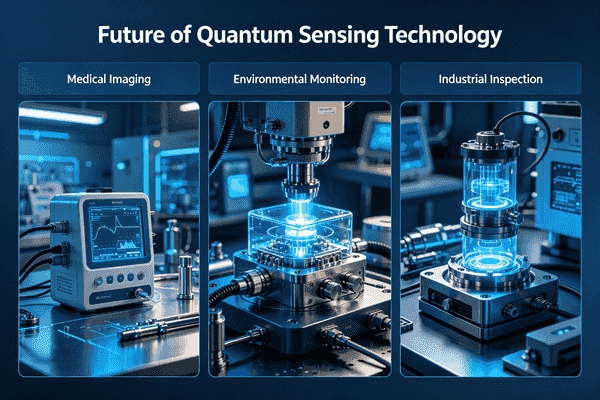
Moving Beyond the Hospital
Right now, we focus on medical imaging. But the future is much bigger. I think about this often. If we can make a sensor small enough for a hospital bed, we can make it smaller. We can put it in a watch.
Imagine a shirt that reads your heart's magnetic field perfectly. It can warn you before a heart attack happens. This is not science fiction. Engineers are testing this today. They are using diamond quantum sensors to track health 24 hours a day.
New Markets for Quantum Tech
These sensors will help many different industries. Let us explore where this tech is going next.
| Industry | Future Use Case | Benefit |
|---|---|---|
| Automotive | GPS-free navigation17 | Cars can drive safely without satellites |
| IoT Devices18 | Smart home health checks | People can track health at home |
| Industrial | Battery testing | Factories can find bad batteries instantly |
I am excited about this future. At Nexcir, we are already helping customers find the parts for these new ideas. We supply the MCUs and modules that connect to these quantum chips. The tech world is moving fast. We make sure our clients keep up.
Conclusion
Diamond quantum sensors2 make high-precision medical imaging possible at room temperature3. We help you source the safe, original components needed to build these amazing new medical devices.
Understanding the need for extreme cold in medical scanners highlights the benefits of diamond quantum sensors. ↩
Exploring diamond quantum sensors reveals their revolutionary impact on medical imaging technology. ↩
Discovering how these sensors work at room temperature showcases their practical advantages. ↩
Learning about nitrogen-vacancy centers explains the core mechanism behind diamond quantum sensors. ↩
Understanding the elimination of bulky cooling systems highlights cost and space savings. ↩
Exploring stability of quantum states in diamond sensors reveals their reliability. ↩
Understanding the measurement of tiny magnetic changes showcases the precision of these sensors. ↩
Learning about superconductors in quantum sensors highlights the innovation of diamond sensors. ↩
Exploring the tight carbon grid explains the structural integrity of diamond sensors. ↩
Understanding disease detection capabilities emphasizes the medical benefits of these sensors. ↩
Exploring detection of weak signals highlights the advanced capabilities of diamond sensors. ↩
Learning about brain activity tracking showcases the potential for neurological applications. ↩
Understanding CVD explains the complex process of creating synthetic diamonds for sensors. ↩
Exploring low yield rates reveals challenges in producing high-quality diamond sensors. ↩
Understanding photodetectors highlights their role in capturing precise data. ↩
Discovering wearable devices showcases the potential for continuous health monitoring. ↩
Exploring GPS-free navigation reveals innovative applications beyond medical imaging. ↩
Understanding IoT enhancements highlights the broader impact of quantum sensors. ↩